
Subscription Lifetime Value is a new metric available in the Activation Insights data model and in our out-of-the-box boards.
Overview
The primary purpose of this metric is to evaluate conversion value in the context of the future value of a subscription.
Subscription Lifetime Value represents the predicted value of a subscription term. The metric is sum of all conversion events multiplied by terms' Subscription Lifetime Value. The Subscription Lifetime Value is calculated per individual term, not per user.
If a user has multiple subscription conversions across different terms over time, each of these conversion events will have its own Subscription LTV.
Currently, Subscription LTV is available only for Subs billing clients using Payment and Dynamic term types.
How It’s Calculated
The calculation of Subscription Lifetime Value is based on retention cohort analysis and the term billing structure.
A retention cohort measures how many subscribers remain active after 1 month, 2 months, 3 months, and so on following the initial conversion.
From this, we calculate the median retention rate up to 52 months after conversion and multiply it by the expected revenues.
Example:
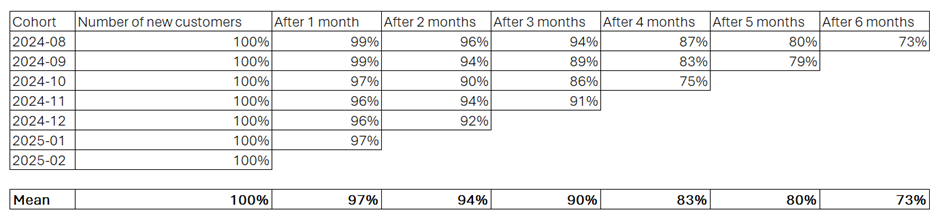
After calculating average (or median) retention rates, we extend the retention curve (or “tail”) up to 52 months and multiply the retention rate by the term billing structure. For Dynamic terms we take in account sequence of periods as they are defined in the term settings.
Example:

Accessibility
The Subscription LTV Revenues metric is being added to the Acquisition Performance board in the following locations:
-
Overview page: A new chart tile titled “Top 5 Terms by Subscription Lifetime Value.”
-
Acquisition page: Added to the existing table “Revenue by Experience over Time.”
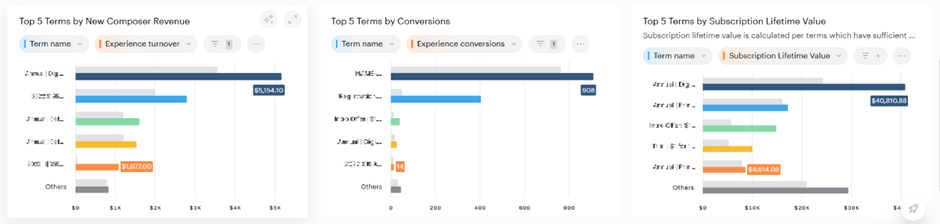
The Subscription LTV Revenues is a standard ACI metric and can be added to any chart or table.
For clients with a full Piano Analytics license, this metric can also be used in any custom report.
Additionally, a new property called “Lifetime Value” (term_ltv) is now populated for the following ACI events:
-
vx.conversion -
vx.conversion.offsite -
subscription.action -
subscription.action.offsite
FAQs
1. Why do some of my term conversions show an empty Subscription LTV?
This usually means there isn’t yet enough data to calculate the expected Subscription Lifetime Value for that term.
Common reasons:
-
The number of new converters is too low.
-
The term was introduced recently, so there isn’t enough retention history.
Calculation thresholds:
-
Retention cohorts are calculated only if there are 20 or more subscription conversions per term within a calendar month. A larger historical volume improves the precision of the Subscription LTV calculation.
-
For monthly terms, at least 3 months of subscription data are required.
-
For longer terms (e.g., quarterly, annual, bi-annual), at least one renewal cycle is required.
In future phases of the LTV project, we plan to optimize the methodology to reduce these thresholds while maintaining accuracy.
2. How often is the Subscription LTV recalculated?
Subscription LTV is recalculated during the first calendar week of each new month.
Each update incorporates the latest renewal data to ensure the most accurate predictions.
3. Do you plan to calculate Lifetime Value from a user perspective?
A user-level Lifetime Value would require combining all subscriptions a user has ever had into a single sequence.
At this time, we do not plan to support this type of calculation.
4. How does Subscription LTV work with multiple currencies?
Subscription LTV Revenues uses Piano Analytics’ automatic currency conversion, recalculating all values into your default currency.
This follows the same principle applied to all revenue metrics.
5. What kinds of calculations can I perform with Subscription Lifetime Value?
Mathematically, Subscription LTV behaves similarly to revenue metrics (e.g., subscription conversion value).
You can:
-
Sum LTV values across multiple dimensions and time periods.
-
Calculate averages or ratios.
-
Use it for comparisons and performance analyses.
Specific use cases may vary depending on your data model and reporting setup.
6. How can I evaluate an A/B test using Subscription Lifetime Value?
If you’re running an A/B test — for example, comparing monthly vs. annual terms or testing trial offers — Subscription LTV Revenues provides a more meaningful comparison than basic revenue metrics.
To analyze A/B test performance:
-
Go to the Acquisition Performance board.
-
Open the Acquisition page and navigate to Revenue by Experience over Time. (You can use any tile on the board, though this one is recommended.)
-
Maximize the tile, then add the following properties and metrics to your chart:
-
Property: A/B test name
-
Property: A/B test variant name
-
Property: Term name
-
Metric: Subscription LTV Revenues
-
-
The table below the chart will display all relevant data for each term, including the KPIs needed to evaluate A/B test performance.
-
If your table is too long, use chart filters to focus on a specific A/B test.
If any terms show 0 values for Subscription LTV, it means there isn’t yet enough retention data to calculate the metric.
7. I want to understand each individual term Lifetime Value. Is that possible?
Yes, it is possible. If you prefer to see the current Lifetime Value per term (rather than the Subscription LTV Revenue metric, which multiplies term LTV by the volume of conversions), use the property “Lifetime Value” (term_ltv) in any of the charts which have Term breakdown.
8. Can I combine Subscription LTV with different dimensions such as country, device, template, or article?
Yes, you can.
Because Subscription LTV is calculated for each conversion event, it can be combined with any conversion-related property.
For example, you can use:
-
Geo-location properties (e.g., country, region)
-
Device properties
-
Content and content profile properties
-
Composer experience properties (e.g., Template name, Experience name)
For a complete list of available properties, refer to the ACI data model documentation.
Summary
Subscription Lifetime Value helps you assess not only the immediate worth of a conversion, but also its long-term potential.
By integrating retention and revenue projections, this metric provides a more accurate and forward-looking view of subscription performance.